Monday, July 11, 2011

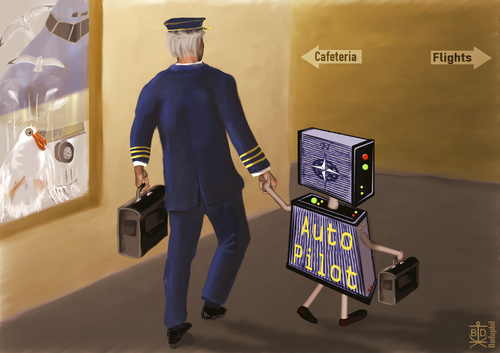
What is an "Auto-Pilot?"

Just about every time there is some media coverage about an aircraft, it's usually an accident of some kind. And, in that coverage there is usually the mention of an aircraft's "auto-pilot." I seriously doubt the general public has an understanding of what an auto-pilot is and what it does and doesn't do. Most people think it's an "ON" button that takes over and the pilots are no longer needed.

First, not all aircraft have an auto-pilot. For the most part, any aircraft you fly on as an airline passenger these days, has an auto-pilot(AP). This is not always the case, however, and I'll talk about that a bit later.

The basic reason for an AP: to ease crew workload. Patrick Smith stated in one of his articles, that when you look at any modern flightdeck, there is no "land at nearest airport" button. However, in the eyes of some completely ignorant douchefaces, the AP has made pilots obsolete, and to be an airline pilot is to be paid lots of money for a job that is all automated anyways. Yes, in the same way that Microsoft Windows has removed the need for any career IT personnel.

So, let us get into some facts. There are two basic types of AP, 2 axis and 3 axis. Most of the regional jets have a 2-axis AP. Without getting too technical, it will hold the wings level and even follow some type of lateral course, and hold a set altitude. Nicer, larger planes will have 3-axis APs, which are coupled with auto-throttles and will also follow a vertical track through the air as well. (called VNAV)

When then the AP is on, the pilot is not just sitting back drinking coffee doing nothing. In many cases, the pilot is still very much flying the aircraft. They are doing so through the AP itself by pushing buttons and turning knobs, rather than making control inputs on the yoke directly. In this case, the pilot is not at all being "replaced" by the computer. The computer is merely an extension of the pilot's hands.

When you are just cruising along at high altitude, its very nice to have a computer to hold the wings level and hold altitude. Ever feel really really tired when driving, and when you have your buddy switch with you and start driving, you are all of a sudden awake? That's the workload difference between just watching over things, and actually be constantly analyzing the motion and position of the car, and putting in all the steering and accelerator pedal inputs.

I have flown routes into places like Atlanta, Chicago, and New York, which are some of the busiest airports in the nation. Workload can be very high in these environments. Especially when bad weather is further complicating things. Having an AP to help you out here can be very advantageous as well, since you're attention will be divided among more than a few areas.

The other side of the coin here is that the FAA seems to be pressing the issue that flight crews operate with the AP on damn nearly ALL THE TIME. They want the AP on shortly after take off, and they don't want it off until a few hundred feet from touchdown. For several reasons, this is a bad idea in terms of a mandate. The AP does lower workload in most scenarios. However, not all scenarios are made easier by AP usage. Visual approaches are a great first example.

During a visual approach, a pilot will be simultaneously slowing the aircraft, banking the aircraft, and pitching the nose over. This is easily done all together when hand flying the aircraft. To do this with the AP, you will be doing three different things, having to use multiple sets of knobs and buttons. You might be selecting a heading mode, then turning a heading knob, then selecting a vertical mode, and setting it with a knob, and then you might be pulling the power back as well, to control your airspeed, or selecting a speed with a knob for a 3-axis AP. Oh, and you then might be arming and tuning and approach mode to back up the visual approach. And in doing so, you're spending a lot of time looking inside when you are in a congested terminal area. Does that sound like a lot of work? You would be correct! It is.

To explain this in a different way, think about driving your car with an AP. Think about driving down a highway, unable to just seamlessly change your speed with the accelerator pedal, and smoothly point the front of the car where you want to go with the steering wheel. Instead you have a button to select if you want your car to maintain a certain speed, or if you want to set up a constant acceleration or deceleration. Then, you have a knob that you can set it with, say, "60MPH." Then, to steer, you have to select the correct mode on your control panel, to change the direction of the car, and then a knob to actually tune in what direction you want.

Lets also consider arming a NAV mode like having your car AP follow a GPS course that you program in. Sounds great. However, there are still things like stop signs, speed limits, and traffic lights to content with, not to mention other traffic! The GPS unit doesn't know about these things. So, just telling your car to go to the shops, and sitting back with your coffee, is asking for some trouble. You need to be aware of everything that is still happening around you. Not to mention, it takes you, the driver, the understanding and knowledge to program the GPS with the correct routing in the first place!

Here's another reason its bad that the FAA wants the AP engaged at all times. In airline flying, there is something called, "a deferral." This happens quite a lot, actually. Way more often than you would ever think. Why is this? Well, honestly, its based on money. There is a large amount of items and systems on an aircraft that have been deemed not 100% necessary. The FAA allows the company to still operate this aircraft, carrying paying passengers, with these systems inoperative. Some of these deferrals have certain procedures for the company and crew to follow when operating the aircraft with these systems being broken, others restrict the aircraft to daytime operations only, etc, etc. It really varies based on what system or systems are inoperative, as you would expect.

Now, there is a scenario called an "RA." This stands for resolution advisory, and basically, this is when two aircraft are on a collision or near-collision course. The aircraft themselves have proximity monitoring systems which will detect this, regardless what the weather and viability is. The FAA mandates that the AP be disconnected, and the evasive maneuver be hand flown. Why? Because the auto pilot will not react in time. Well, it is perfectly legal for an aircraft to be dispatched for a flight with a full load of paying passengers, into crap weather, with the auto pilot deferred. Now, if all pilots are following the FAA's recommendation to only fly with the AP on, we might not quite be as good at handflying as we should be. After all, we are "pilots," right?

Of course, none of this is even touching on just how often a pilot has to override the automation in an aircraft because its doing something unexpected. It could be for a million different reasons why the aircraft doesn't do what it should do, but regardless of the reason, the pilot needs to be vigilant of the plane at all times and not let the airplane do anything unexpected. I have seen aircraft automation do weird things countless times. Sometimes, its because I set something up wrong. (computers are famous for the whole "garbage in, garbage out.") Other times, its a error or failure in the AP itself. Other times, something totally weird happens. No idea why, but the plane just does something totally strange and unexpected. Just like Microsoft Windows does things, usually on a daily basis, that you don't expect.

Either way you slice it, the number of times that I had to "take back" the plane from the AP, and put it back on track, is nearly countless. For someone to make the argument that aircraft accidents are caused by pilot error, and taking the pilot out of the plane will drastically improve air safety, is to reveal their true ignorance and completely ignore the actual underlying causes of these accidents. Don't forget, if the AP does something unexpected and turns the aircraft into a mountain, it's still put down to pilot error, since the pilots (yes, plural!) didn't catch the error and do something about it.

An AP is really just another tool for pilots to use. When used properly, just like electronic engine controls, weather radar, etc, it will help pilots manage tasks and contribute to a safer operation. People who really think an AP removes the need for a human pilot, truly have no idea what they are talking about and are just making noise trying to get attention. Do you think the plane full of survivors on Sully's Airbus that landed in the Hudson would rather be on a plane that was flown solely by a computer? How about Al Haynes' DC-10 that crashed in Sioux City?

Above image from toonpool.com

Wednesday, July 6, 2011

Rollaboard Maintenance


Your first question might be, "What the hell is a rollaboard?" If so, this post might not be for you, but just to clarify, a Rollaboard is the wheeled luggage that a flight crew member will use to carry around all their personal belongings while on a trip. (i.e. shirts, jeans, undies, socks, deodorant, toothbrush, etc, etc, etc.) I believe the term comes from that fact that air crews sometimes will fly on a lot of different airplanes during a multi-day trip. So as they go from plane to plane, they have their stuff and, "roll it aboard."

One of the most common flight crew luggage choices is made by a company called, "Luggage Works." These have been around for a while and have gone through quite a few iterations to become one of the best rollaboards you can have. Especially when flying in the regionals when most planes don't have a place for you to keep your rollaboard in the flightdeck. Some don't even have a place for you to keep your rollaboard in the cabin! Yup, on some regional aircraft, the crew bags ride in the cargo bin just like the passenger bags. The LW bags are very stout. They aren't the lightest bags you will find, and not the cheapest, but they will last better than just about anything else.

I love mine because of its size, its durability, and two other key features that I couldn't find on other bags: a long handle and real roller bearings in the wheels. And, those wheels are placed at the widest possible places for maximum stability. This might not be necessary for people that only fly a couple of times each year, but for people that fly around 250-200 days per year, and considering just how much time is spent pulling it around, its worthwhile to have something top notch.

Well, its been more than few years since mine first entered service. It was in need of some basic maintenance. Others with LW will attest to regular screw-tightening rituals. I have also noticed some screws missing now. So, I decided to put a bit of time and money into this thing. After all, it is my, "Mobile Home."

For those interested in some maintenance on their LW bags, here's a few things I can recommend. The closest match for the external screws that loosen from time to time, are #8 x 5/8" sheet metal screws that can be found at any hardware or home improvement store. A pack of ten screws will run you a buck or two. Also worth noting, the 3 screws along the bottom edge of the front of the frame on the LW, are #8 x 1/4" sheet metal screws. They are the same thread and width as the others, just shorter.

I highly recommend taking 10 mins out of your day to use thread lock all these screws. I use this product from Loctite. Go one by one, around the frame, remove a screw, squirt some of this goo on the threads of the screw, and then screw it back in. (Cordless drill with Philips screwdriver bit exceedingly recommended here.) Keep some paper towels at hand as this loctite stuff can be slightly messy, but it will really assist in those screws not working loose.

My wheels are still in decent shape, but when it comes time to replace those, all it takes is a visit to any rollerblade or sporting goods store as the LW bags use rollerblade wheels and bearings. So, pick whatever you like and you're set to go there.

All in all, I think the LW bag is the best you can have for this career. It's also quite often you see flight crews from all sorts of companies using this bag, so I'm not alone in this opinion. If your interested in one, you can find more info about them at http://www.luggageworksonline.com/.

Wednesday, June 29, 2011

Bags

There are checked bags, carry on bags... and then there's ass bags. Anyone that has flown into and out of EWR/LGA/JFK knows that ATC flow control delays are a part of the norm. On this day there was a line of weather to the west of Newark and it was hosing up all the arrival and departure routing. Juuust as the passengers started boarding the plane in Detroit, we got word that we had been given a 2 hour delay. We were stuck at the gate. Considering the length of the delay, we let everyone stay in the terminal so that they had access to space, real bathrooms, restaurants, etc.

We decided to start boarding the flight 40 mins before our slot time. That should be enough time to get boarded plus another 10 mins to taxi out to the runway and be ready for our departure slot time. The gate agent must have had other ideas, however. It became obvious that she was only wanting to get the door closed by our slot time. It was a downright struggle to just get people boarded in 30 mins. Unreal. Then, since the flight was so late, the tug and tug driver were somewhere else. So, we had to call our operations people and try to get a tug to come back and push us off the gate. ATC usually gives you +/-5 mins leeway on your slot time. We arrived at the end of the runway right at the +5 mins. If we'd been one more minute late, we'd likely be sitting off to the side, or even perhaps returning to the gate to await another slot time. Needless to say, we were pretty pissed with the gate agent and ground crew.

We blasted off, and headed to EWR. We had some storms to go around, we had some speed reductions and delay vectors to hold us back further while enroute. Again, not really out of the norm considering the weather. We even had to be in contact with dispatch to verify the new routing with them to ensure we had adequate fuel to accept the routing and still have enough left for our alternate airport as well.

As we got closer to the line of weather, it was evident that we'd have to find a path through the storm cells. We had a few options, but one seemed the best course, so we stuck with that. We punched through a decent gap and only got bumped around for a short time. Wasn't too bad at all. After that, we got vectored around some of the smaller storms as we descended down below 10,000ft and got into the terminal area. Things around the NYC area can already be tense due to the traffic volume, so having weather in the area just adds to it. Needless to say, it was exceedingly busy for the last 30 mins of the flight.

We managed our way through it all and even stayed fast on final approach (per ATC request) to help them out with spacing for aircraft in trail of us. Then, we slowed on short final, and I even managed to squeak out a sweet greaser of a landing with the gusty crosswinds (pure luck, I'm guessing). I was feeling pretty good about it all. It was a lot of work and a lot of items to juggle. But, we worked together as a crew and made it work.

Ground control in EWR was busy as usual and they gave us a pretty complicated taxi route. Of course, there were about 40 other planes taxing around us, coming and going. So, even though we were on the ground, it wasn't time to sit back and let our guard down. We followed everything to the T and got to the gate.

Once we got parked, another wet towel was thrown into the goings-on. The jet bridge didn't work. The ramp personnel fought with it for at least 5 mins while the passengers were waiting to get off the plane, a full 2 hours later than originally planned.

Now, I know things happen, but I will say this. I was in EWR only a few days prior. And that very same damn jet bridge didn't work then either! I don't buy the fact that this very jet bridge ONLY goes on the fritz when I'm in town. I don't buy it for one minute. Those personnel KNEW that jet bridge didn't work. Yet, they still spent 5 mins dicking with it. Then, they took another 10 mins to get their act together so that we could unload the passengers via the airstairs and then have them walk up the metal stairs up into the jet bridge. And, we had two passengers that required wheelchairs. No, they weren't ready for that either. That was another 10 min wait after everyone else had gotten off the plane. They totally and completely dropped the ball. Why is it that only the flight crews seem to be the ones held to the "high customer service standard?"

Most people, as usual, were at least understanding of the weather and traffic delays. I think the jet bridge issue was the final straw and really ticked some people off, myself included. I knew it had been a problem there for several days.

However, what REALLY did it for me, was some suit wearing cock monkey who got off the plane, looked at the crew and said, "Piss poor job today, boys!" It took every ounce of my being not to grab this fat, ignorant and arrogant ass clown by the throat and rip him 17 brand new assholes, R. Lee Ermey style. All that was going through my head was "Ex-fucking-scuse me??? I just busted by ass, lost 2 hrs out of MY sleep for tonight, and battled my own company every step of the way to get you here as fast as I could and as safely as possible. I did not a single thing wrong. Not one. I made this flight happen. I got you here to your destination safely. Don't you dare pull that shitty little bitch ass adolescent attitude with me about how I did a piss poor job. You don't like flying this airline? Go find another! Go! Get the fuck off my aircraft. I don't want your damn business if you're such a colon roaster. It's people like you that do nothing but piss and fucking moan about every damn thing in the world. You're just a miserable human being and I don't care for all my other passengers to have to deal with a dick face like you in the cabin. Everyone else here will be happier without you around. Get lost."

Was I bitter? Yeah... a bit. The lesson? The flight crew is the most visible part of the airline operation. However, they are certainly not always the ones to blame when things don't go well. In fact, they are usually the ones doing everything they can do make things happen while pushing against every other department in the company.

Monday, June 6, 2011

Adventure in Decline

I'll be the first to admit, I'm not a huge movie fan. I don't dislike movies, but I just don't think you get what you pay for going out to see a movie anymore. I did, however, finally see "Amelia" on DVD last week, and it sparked a bit of thought. In Amelia Earhart's day, aviation was a completely different industry than it is today. Adventure in this line of work is not what it once was, and I think it peaks extremely early in a commercial pilot's career.

Now, it's certainly worth noting up top that it is a good thing that "adventure" isn't a normal component of part 121 air travel. I'm pretty sure the traveling public likes it that way. They want dull, boring, and routine. And, that's fair enough. I understand where they are coming from with that, but it certainly does take away from the romantic pilot image.

I think one of the biggest adventures for a new pilot is that first solo flight. I think it might even be the pinnacle for a pilot's career. It is a tremendous feeling the first time your CFI turns you loose for a few laps around the field. At this point, you likely have very little in the way of hours in your logbook, and much of what you're about to do, is very new. The first solo is an adventure. The first time you part ways with the tarmac, and its just you and the plane. It's your first real "gut-check" in flying. There's no one else to make any inputs on the controls. No one else to take up any space inside the cabin. Up to that point, your entire brief flying career has been under the guidance of your instructor. Then, for the first time, its just up to you to fly this bird around the patch. It really does feel like uncharted territory. Even though your CFI is confident in your skills, there is certainly a feeling of risk and uncertainty. The first solo is usually an event that every pilot remembers and enjoys looking back on.

From that point on, as a pilot progresses through his/her career, I think the "adventure" element begins to decline. As a pilot completes the instrument rating, the commercial single and multi-engine ratings, there are little adventurous bits here and there, but I don't think they compare to that first solo in terms of sheer exhilaration.

This is even more pronounced later in a pilot's career. As a pilot learns to fly bigger and faster aircraft, type ratings are earned, and pilots start flying as a crew, not just by themselves. It wasn't too long ago that I had my first flight as a regional airline captain. If you would have asked me, back in my private pilot days, what it would feel like to fly my first flight as a 121 captain, I'd have been using words like, "Awesome, incredible, exciting, kick ass, etc." Now, this isn't to say that this wasn't a milestone flight in my career. It was a very enjoyable and satisfying thing. However, that sheer sense of adventure was notably absent.

Why is this? Well, adventure certainly is a wonderful thing, but it's also closely associated with something called, "Risk." You see, as you fly bigger, faster, and more expensive aircraft, risk is something to be minimized. By the time you make a line flight, even as a new first officer, much of what you are about to do, has already been rehearsed, rehearsed and re-rehearsed. This is in effort to make things as routine as possible for you and the operation. This indeed is a good thing, seeing as how the first time you fly your actual aircraft, you will have paying passengers behind you. They don't want to even think about you having an adventure up there in the front of their plane.

So, this is really just a little note to those just getting started in or about to start their aviation careers. I know you're focused on getting through those ratings as fast as you can, and all you want is to be done with training and flying big fast jet somewhere. But trust me, don't short change that enjoyment of those early ratings, and mostly importantly, that first solo.

Saturday, May 28, 2011

Small gifts


My last trip had a bit of a stressful beginning if I'm honest. My commute in wasn't much fun. I also had to head in to base a day early due to the early start time. Once I got to my hotel that first night, it was time to have some of the food that I packed along for the trip. It was at that time I found that the ice pack I used to keep some of my food cool decided to leak. So, some unnamed chemical goo was all over my food and other things in my flight case as well. The air conditioning unit in my room was quite noisy to say the least. The mattress was about as soft as the floor as well. *sigh* Nothing was catastrophic, but a lot of little annoying things seemed to be popping up.

In the morning, I was up early since I didn't sleep all that well, so I cut short the uncomfortableness, and went down for breakfast. I had a little bit to eat and some coffee. I noticed a family in the lobby waiting to go to the airport, perhaps on vacation. The youngest of their children was a very cute little girl, around 5 or 6, I would guess. When the van pulled up in front of the hotel and we all started making our way to the front, this cute little girl walked right up to me and handed me this little item pictured above. I don't know what its made of, but it appears to be little plastic fit-together pieces of some kind, in the shape of a Space Shuttle Orbiter. Needless to say, I really didn't expect it at all. I was fairly speechless to say the least. However, I had to say something. So, I managed to utter, "Is this for me?" She simply nodded yes and then walked away back to her family. I said a thank you and looked up at the family, with somewhat of a, "Is this for real? Is this something she isn't supposed to give away?" I was really taken by surprise. Her Mom said with a smile on her face, "She's been looking for a pilot to give it to." I replied, "I guess I was in the right place!"

Looking back, there was a lot more I could have done or at least said. "So, whats your name?" "When did you make this?" "Do you like the Space Shuttle?" I should have offered up a little more conversation with the little girl, but to be honest, I was just very much in shock. To me, it was a rough start to a trip. Just another night in a so-so hotel before heading in to work. I'm used to dealing with poor treatment, crappy opinions of me and my work by stuck up mainline pilots, crap pay, crap hours, upset pax, leaking ice packs. Then all of a sudden, it just didn't seem so bad. Here was a little someone that seemed to look up to me. It was a very small little thing, but it really meant an awful lot to me.

I think the plan will be to put a string through this little Orbiter, and make it an Xmas tree ornament from here forward. So, little girl, I didn't catch your name, but I will certainly remember you. Thank you!

Tuesday, May 24, 2011

Busy BOS

Pretty cool little video showing about an hour of traffic at Boston Logan, compressed into under 3 mins.

Friday, May 13, 2011

Airport Exercise

Do you loathe those long hours spent waiting in airports? Here's something for you to try!